
Battery System — LFP Chemistry
We exclusively specify LiFePO₄ (LFP) battery chemistry for commercial and industrial energy storage applications.
LFP offers superior cycle life (6,000+ cycles at 80% DoD), high thermal stability, and a chemistry profile that eliminates cobalt-related safety concerns — making it the standard choice for stationary C&I storage worldwide.
Cell-level monitoring, intelligent cell balancing, and modular rack design ensure that capacity degradation curves remain predictable and warrantied over a 10-year performance period.
Typical Battery Specifications
Hybrid Inverter — Power Conversion System (PCS)
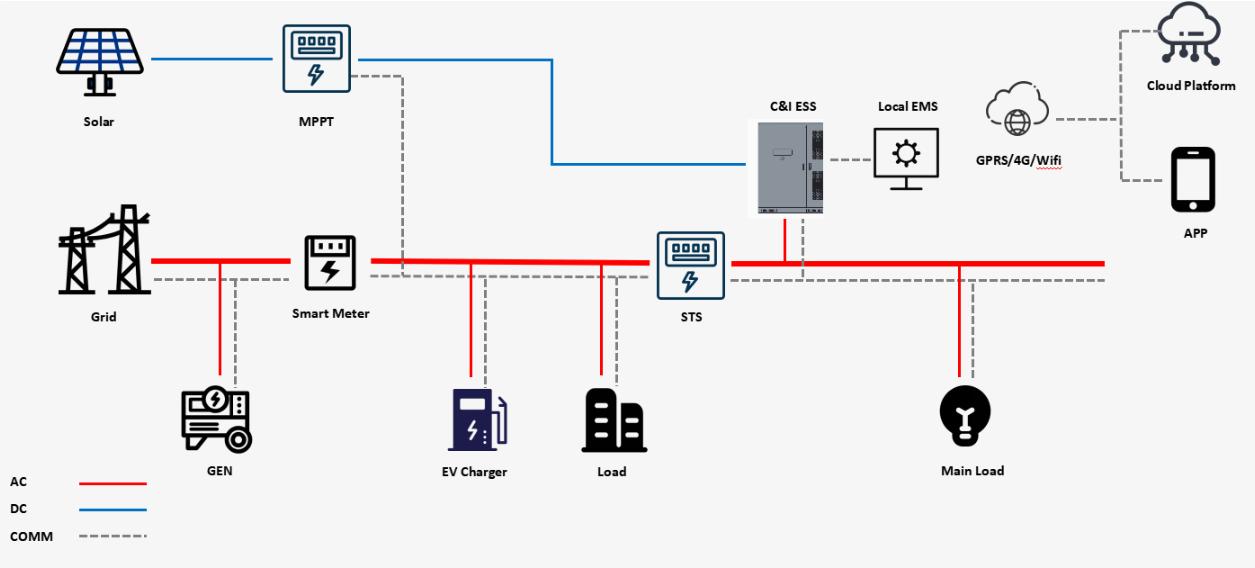
The bidirectional hybrid inverter manages energy flow between the battery, the AC load, the grid, and optional on-site generation (solar PV or diesel).
Modern C&I hybrid inverters operate in grid-following or grid-forming mode, enabling:
• Peak shaving — discharge during peak tariff windows
• Energy arbitrage — charge off-peak, discharge peak
• UPS/resilience mode — seamless grid-to-backup transition
• Grid support — reactive power, frequency response
Sizing is typically 40–60% of battery kWh capacity, enabling 2–4 hours of full discharge at rated power.
Typical Inverter Specifications
Energy Management System — Cloud + Edge
The EMS is the intelligence layer of the ESS — continuously optimizing when to charge, when to discharge, and how to balance financial returns against grid constraints and battery health.
Our standard EMS architecture combines:
• Edge controller — real-time local dispatch, sub-second response
• Cloud platform — remote monitoring, analytics, OTA updates
• Day-ahead tariff integration — forecast-optimized dispatch
• Multi-site management — single dashboard for portfolio-scale assets
Operator access via web portal and mobile app. API available for integration with building management systems (BMS) and utility portals.
EMS Specifications
Grid Interface & Safety Systems
Every EMoreShare ESS is designed to meet the interconnection and safety standards required in the target deployment market — from European CE requirements to country-specific grid codes.
Grid Interface includes:
• Grid-tied or island mode operation with automatic transfer
• Anti-islanding protection (per IEC 62116)
• Reactive power compensation and power quality management
• Remote grid connection/disconnection capability
Integrated Safety System includes:
• Multi-stage battery protection (over/under voltage, overcurrent, thermal)
• Fire detection and suppression (HVAC-linked gas detection)
• DC isolation monitoring and AC/DC circuit breakers
• Emergency stop and rapid shutdown per local regulations